
Deal 1: The 1% Rule, $27K Down, $146K Equity.
Committed: $27K · Current Equity: $146K
STRATEGY
Buy and Hold
PROPERTY TYPE
Single Family
ACQUISITION
Turnkey
ACQUIRED
2020
OVERVIEW
In 2020 I was ready to buy my first rental property.
I did not have a sophisticated underwriting model yet.
I was not fully sold on real estate as my main engine.
I was not even all the way back into the entrepreneurial mindset.
What I had was the 1% Rule.
I learned it from listening to Bigger Pockets.
It made sense. It was easy to grasp.
So I used it.
I looked at deals every night after work.
9PM to midnight. Five to six months straight.
Until I finally closed one.
This is that deal.
THE 1% RULE
A quick screening tool. Monthly rent should equal at least 1% of the purchase price. It is a filter to eliminate deals that cannot pencil, not a full underwriting.
FINANCIALS ——
THE MORTGAGE
WHAT I PROJECTED AT PURCHASE
The underwriting that got me to yes
THE CASH FLOW QUESTION
Here is where I will be straight with you.
The model projected about $43 a month in margin.
That is razor thin. Barely above break even.
Six years in, I do not believe this property has produced meaningful positive cash flow.
Capex and opex ate most of it.
I could dig through six years of tax returns and try to reconstruct an exact number.
I am not going to pretend I tracked every dollar perfectly.
I would rather tell you that than invent a clean number.
What I can measure cleanly is equity.
How much the asset is worth. How much I owe.
The difference is real. The difference is the story.
WHAT WENT WRONG
A few weeks after my first resident moved in, I had a water backup. Several thousand dollars.
The restoration company quoted me one price. The moment I filed with insurance, they tripled it.
My very first deal and I was already dealing with a bad actor.
That claim followed me for five years. I call it insurance jail.
Elevated premiums the whole time. I only got out last summer.
Over six years other things came up too. Some went wrong. Some went right.
That is what holding real estate actually is.
The longer you hold, the more life happens to the property.
RETURNS
Cash flow was not the win here.
Equity was.
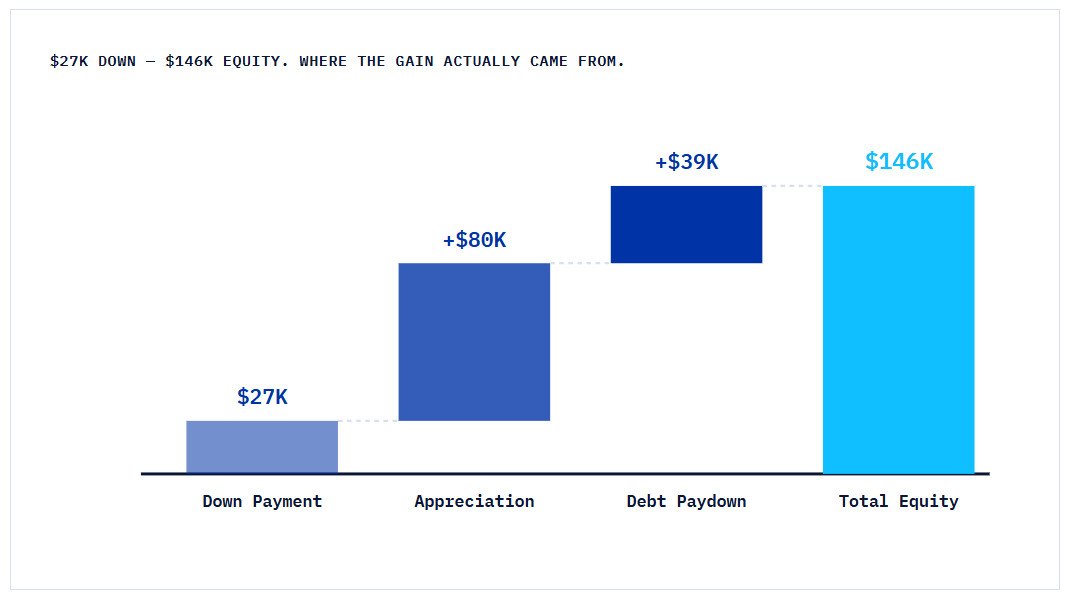
$27K down — $146K equity. Where the gain actually came from.
EQUITY POSITION
Appreciation alone is a 74% increase on the purchase price. The debt paydown was funded largely by the resident, not me, though I did accelerate it early on with curtailments.
POTENTIAL DEPRECIATION
An estimate (see glossary for how the tax benefit is actually calculated)
Important: this is the deduction, not a tax refund. It is not $3,100 in your pocket. It means roughly $3,100 of income is shielded from tax each year. Your actual dollar benefit is that number times your marginal tax rate, which varies by person.
THE SCOREBOARD ( FROM $27 , 000 DEPLOYED )
$146,000 equity
Appreciation + Debt Paydown: $146,000 equity
Tax benefits (depreciation): additional upside
Cash flow: roughly flat
The equity is measured. The tax benefit is estimated. The cash flow is honest.
WHAT I LEARNED
The 1% Rule got me in the door.
It was not enough to underwrite the deal properly.
Break even was not a margin of safety.
It was a risk I did not fully understand yet.
What saved this deal was appreciation and time.
Neither of those are guaranteed on the next one.
My due diligence standard at the time was simple. If the deal cleared break even it was worth pursuing. I do not recommend this.
Break even is not a margin of safety. One vacancy, one repair, one bad contractor and you are writing a check out of pocket. I learned that firsthand a few weeks in.
WHAT COULD HAVE MADE THIS DEAL STRONGER
Underwrite for real cash flow, not just break even.
Budget capex and vacancy as line items, not afterthoughts.
Vet contractors before an emergency forces the choice.
Treat appreciation as upside, never as the plan.
Build in a margin of safety for the unexpected.
GLOSSARY
1% Rule — A quick screening tool. Monthly rent should equal at least 1% of the purchase price. A filter, not a substitute for full underwriting.
Total Equity — The estimated market value of the property minus the outstanding loan balance. The cleanest way to measure what a deal is actually worth to you.
Curtailment — An extra payment applied to loan principal beyond the required monthly payment. It reduces the balance faster and cuts total interest. I made curtailments the first 18 months, then stopped to save capital for the next property.
Capex vs Opex — Opex is routine operating cost such as management and minor repairs. Capex is large one-time cost such as roof, HVAC, or water damage. Both eat cash flow. Capex is the one that surprises new investors.
Depreciation — A non-cash tax deduction on residential rental property, taken over 27.5 years. The common estimate: allocate roughly 80% of purchase price to the building (land is not depreciable), then divide by 27.5. On this deal that is about $3,100 a year of income shielded from tax. The actual dollar benefit is that figure times your marginal tax rate, which varies by person.
Blueprint Cee
Nothing here is financial, tax, legal, or investment advice. I am an investor sharing my own experience and what I have learned. I am not an accountant, financial advisor, or tax professional. Numbers are estimates based on my own records and may not be exact. Always consult a licensed professional before making investment decisions.
